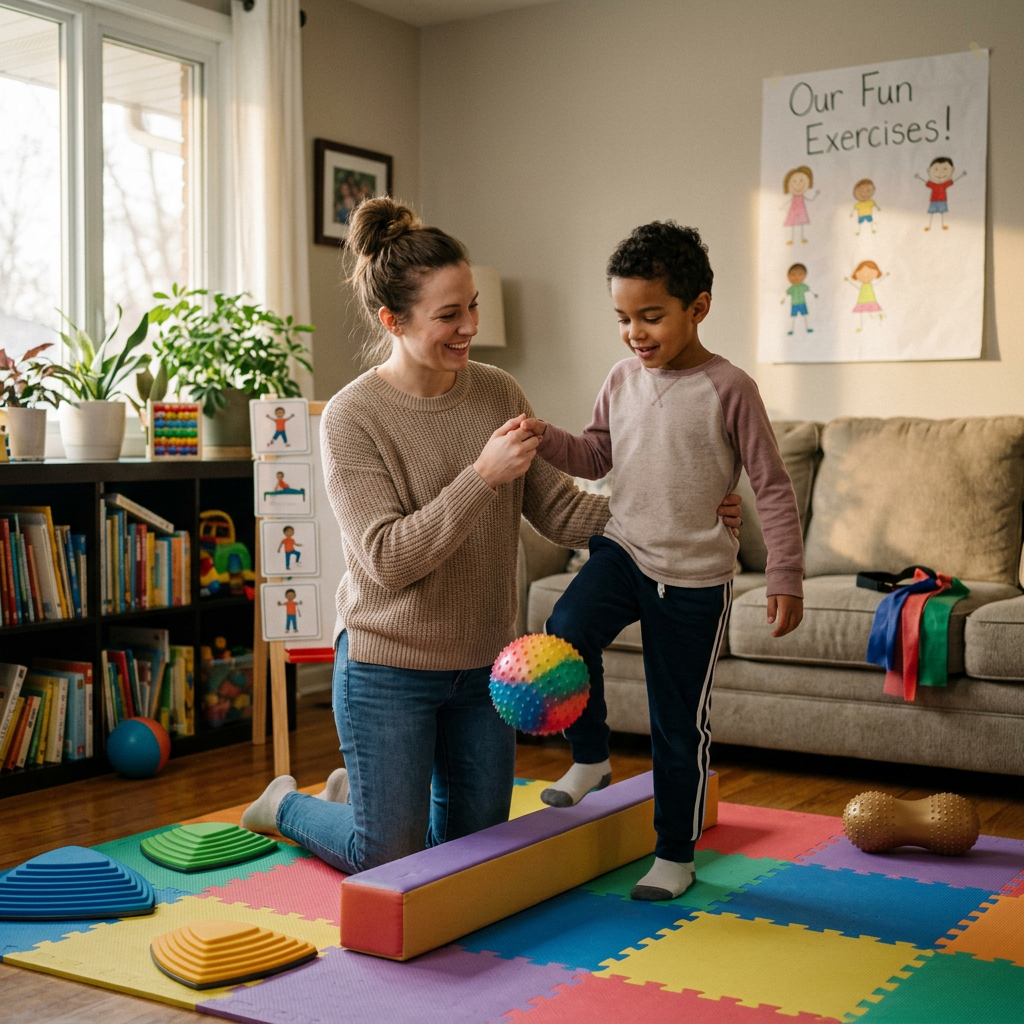
Nobody hands you a manual for the other six days.
The therapist gets one hour a week, maybe two. They are trained, prepared, and paid for that hour. You get everything else. The breakfasts, the car rides, the homework sheet on the fridge, the Tuesday night refusals. And somewhere in there, you are supposed to be “supporting therapy at home,” a phrase everyone uses and nobody quite explains.
Here is the explanation. Supporting child therapy at home comes down to four jobs. Get the right practice content from your child’s therapist. Build a tiny routine that carries it. Keep the pattern steady over months, imperfectly. And have a plan for the days it all falls apart. None of the four requires clinical training. All four run on the same fuel, which is a simple written log.
This guide walks through each job, links to a deeper article on each one, and shows you how the log ties the whole thing together.
Key Takeaways
- Your role at home is structural, not clinical. The therapist owns what gets practiced. You own when, where, and how consistently it happens.
- Small daily practice inside an existing routine beats long weekend sessions, because children build skills through repetition in predictable settings.
- Consistency means mostly, not always. Good enough consistency sustained over months outperforms six perfect weeks followed by burnout.
- Refusals and skipped days are normal parts of the process. Handled calmly and logged honestly, they become useful information instead of guilt.
- One line of notes per day is the connective tissue. It turns your six days into something your child’s therapist can actually see and use.
Your job and the therapist’s job are different jobs
Before the four jobs, one ground rule that protects everything else.
The content of home support comes from your child’s therapist. The specific exercises, the way to respond to a specific behavior, whether a reward system is a good idea, how hard to push. That is clinical territory. Family involvement helps most when it happens inside a partnership with the professional, which is exactly the model described in ASHA’s family-centered practice framework: the professional guides the plan, the family carries it into daily life.
What the therapist cannot do from the clinic is run your Tuesdays. The routine, the timing, the restart after a rough month, the calm response to a child under the dining table. That is your territory, and it is the territory this guide covers.
If you take one sentence from this page, take this one. The therapist picks the what. You build the when.
Job 1: get the right practice content
Home support starts with a conversation, not a Pinterest search.
At the next session, ask one question. What should our practice at home look like right now? Write down the answer, including what a good attempt looks like and what to do when your child struggles. If you have your own activity ideas, bring them to that same conversation as suggestions rather than starting them on your own. Ideas are welcome. Freelancing is risky, because an activity that looks harmless can practice a skill the wrong way.
Our full article on home practice ideas to discuss with your child’s therapist gives you seven conversation starters, each framed as a question to bring to the professional. And if you tend to go blank in sessions, keep a running list using our questions to ask your child’s therapist.
What you should leave that conversation with is small. One or two activities, clearly understood. Not a curriculum.
Job 2: build a tiny routine to carry it
Practice content without a routine becomes the sheet on the fridge. Dated three weeks ago, held up by a banana magnet, technically still the plan.
The fix is structural. Attach practice to an anchor that already happens every day, keep the practice itself to a few minutes, and end with one written line about how it went. Anchor, practice, log. Five minutes, most days. Predictable routines are one of the most reliable supports for young children’s learning and sense of security, which is why pediatric guidance like the AAP’s advice on family routines keeps returning to the same theme. A skill practiced inside a familiar routine has somewhere to live.
The size matters more than parents expect. Five focused minutes daily usually does more than forty minutes once a week, and it survives real life in a way ambitious plans do not. The full structure, including a minute by minute example and what to keep in the practice basket, is in our guide to creating a simple 5 minute home therapy routine.
Job 3: keep the pattern steady, imperfectly
Here is the trap that ends more home support than any tantrum. Perfectionism.
A family starts strong, misses a week, feels like a failure, and quits. The streak was the standard, so the broken streak became the ending. Meanwhile the family that plods along, missing days, restarting, missing again, restarting again, quietly accumulates months of repetition. Repetition over time is what your child’s skills are built from.
So the standard to hold is good enough consistency. Most sessions attended. Practice happening more days than not, in whatever small form survives that week. Breaks followed by restarts, every time, without makeup math or guilt. And honest reporting to the therapist about what actually happened, because a therapist working from a real picture can adjust the plan, while a therapist working from a polite fiction cannot.
The full argument, including the three layers of consistency and how to restart after a bad stretch, is in why consistency matters more than perfection.
Job 4: have a plan for the hard days
Some days your child will refuse. Flat out, arms crossed, under the table. This is normal, it is developmental, and it is survivable, but only if you have decided in advance what you will do.
The short version is a ladder. Lower the stakes first. Then shrink the task to one attempt. Then offer a small choice inside the routine. And if none of that lands, call a rest day on purpose, out loud, without drama. The one move that is never on the ladder is forcing practice through escalating distress, because a child who learns that practice means tears stops showing up long before you do.
Rest day is the exact wording we use in our Daily Log, and the wording is deliberate. A day without practice recorded as a rest day reads like a decision. Recorded as a blank, it reads like a failure, and failures pile up into quitting. The complete playbook, including scripts and when refusal becomes something to bring to the therapist, is in how to handle days when your child refuses home practice.
The thread through all four jobs: the log
Look back at the four jobs and notice what each one needs.
Job 1 needs you to remember what the therapist said. Job 2 ends every practice with one written line. Job 3 runs on honest records of what actually happened, skips included. Job 4 turns refusals and rest days into notes the therapist can use.
Four jobs, one fuel. A written log, kept simply enough that you will actually keep it.
The format that works is one line per day. What you practiced, or that you rested, plus one thing you noticed. Thirty seconds. Over a month, those lines become the clearest picture of the six days your therapist never sees, and they change the quality of every session conversation. Instead of “it went okay, I think,” you have patterns. Practice happens easily after breakfast, never after 5 pm. Refusals cluster around the speech cards. The new strategy worked twice this week.
This is the same documentation habit behind tracking your child’s therapy progress, and if your child is newer to therapy, it pairs with our complete guide to preparing for child therapy. Track the sessions there. Support the six days here. The log is the bridge between them.
You can start with a single page.
Try the Daily Log for one week
Download the free Daily Log sample page. One line per day, thirty seconds to fill, with Done, Partly, and Rest day checkboxes built in.
[Get the free Daily Log page →]
We will send it to your inbox, along with occasional practical notes for therapy parents. No spam, unsubscribe anytime.
If the one week test earns its place on your counter, the full system is ready when you are. My Child’s Therapy Journey: A Parent Therapy Binder holds the Daily Log alongside session notes, goals, weekly summaries, and a wins wall, so the four jobs of home support live in one place instead of on scattered papers.
FAQ
What is the parent’s role in a child’s therapy?
Your role is structural rather than clinical. The therapist decides what gets practiced and how. You decide when and where practice happens at home, keep the routine reasonably consistent over months, respond calmly on hard days, and report honestly on what you observe. That partnership between professional guidance and family follow-through is where most progress gets built.
How can I support my child’s therapy at home without training?
You do not need clinical training. Ask your child’s therapist exactly what to practice, attach that practice to a short daily routine, keep a one line log of how it goes, and bring your notes and questions to each session. Everything clinical, including new activities and reward systems, goes through the therapist first.
How much time does home therapy support take each day?
For many families, around five minutes of focused practice a day plus thirty seconds of logging is enough to be genuinely useful, though the right amount depends on your child’s goals, so confirm it with your therapist. Consistency over months matters more than the length of any single practice session.
What if we keep missing practice or sessions?
Missed days and even missed weeks are normal. Restart small, skip the makeup math, and tell the therapist honestly what happened so they can adjust the plan. If something specific keeps breaking your consistency, like scheduling or daily refusals, raise it as an agenda item. Those are solvable problems once they are visible.
Should I do therapy exercises at home that I found online?
Bring them to your child’s therapist as ideas to discuss before trying them. Activities that look harmless can practice a skill incorrectly or work against your child’s current goals. The therapist who knows your child’s plan is the right filter for anything new, including apps, videos, and reward systems.
Attunement Family articles are documentation and organization guidance for parents. They are not medical or therapeutic advice and do not replace your child’s therapy team. Always discuss your child’s home practice plan with their therapist.

Leave a Reply