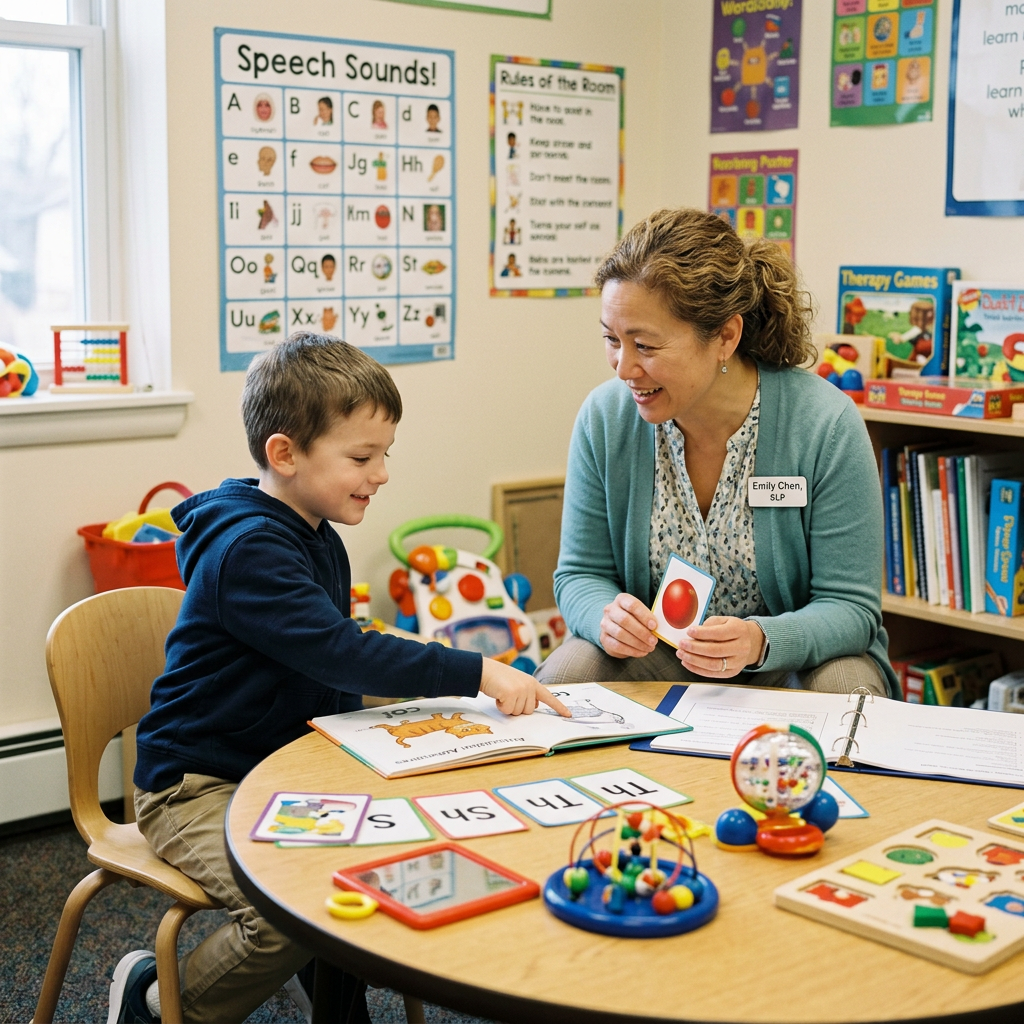
The clinic door opens and a therapist kneels down to your child’s eye level. She is holding a bin of toys, not a clipboard. Your child looks at the bin, then at you. You realize you have no idea what the next 45 minutes are supposed to look like.
Here is the short answer. Speech therapy for kids usually starts with an evaluation, where a speech-language pathologist assesses how your child communicates through play, observation, and questions for you. After that, your child attends regular sessions built around specific goals, and you get a home practice role between visits. Most of it looks like structured play. Almost none of it looks like a classroom drill.
This article walks you through each stage so the process feels familiar before it starts. It will not tell you whether your child needs speech therapy. That question belongs to a qualified professional who has actually met your child.
Table of Content
Key Takeaways
- Speech therapy covers far more than pronunciation. It can address understanding language, expressing ideas, social communication, stuttering, voice, and feeding.
- Your child’s therapist is a speech-language pathologist, or SLP. In the US, the strongest credential to look for is ASHA certification, written as CCC-SLP.
- The first appointment is an evaluation, not a treatment session. Expect play-based assessment, questions about your child’s history, and a written report afterward.
- Regular sessions typically run 30 to 60 minutes and look like guided play with a purpose behind every activity.
- Parent involvement is one of the strongest predictors of progress. Your job between sessions matters as much as the sessions themselves.
- How long therapy lasts varies widely by child and goal. Only your child’s SLP can give you a realistic timeline, and even that will be an estimate.
What Speech Therapy for Kids Actually Covers
Many parents arrive expecting pronunciation practice. Saying the R sound. Fixing a lisp. That is part of the field, but only one part.
A speech-language pathologist works across several areas:
- Speech sounds. How clearly your child produces sounds and how understandable they are to others.
- Receptive language. How well your child understands what is said to them, from single words to multi-step directions.
- Expressive language. How your child puts thoughts into words, gestures, or other forms of communication.
- Social communication. Skills like taking turns in conversation, reading tone, and adjusting language for different listeners.
- Fluency. Patterns like stuttering, including the tension and avoidance that can come with it.
- Voice. Issues with pitch, volume, or vocal quality.
- Feeding and swallowing. Some SLPs also work on chewing, swallowing, and mealtime skills, because the same muscles are involved.
One more area deserves its own mention. For children who communicate with few or no spoken words, SLPs also work with augmentative and alternative communication, or AAC. That can mean picture boards, sign-supported speech, or speech-generating devices. If this is your child, therapy is not about forcing speech. It is about building reliable communication in whatever form works.
Your child’s plan will focus on one or two of these areas, not all of them. The evaluation determines which.
Who Provides It, and Where
The professional running your child’s sessions is a speech-language pathologist. You will hear SLP, speech therapist, and speech teacher used interchangeably. They mean the same person.
In the US, look for state licensure plus ASHA certification, shown as CCC-SLP after their name. That credential means the therapist passed a national exam and completed a supervised clinical fellowship. Some clinics also use speech-language pathology assistants who deliver practice activities under an SLP’s supervision. That is a normal staffing model, not a shortcut, but the SLP should still be the one setting goals and reviewing progress.
Where sessions happen depends on your child’s age and how services were arranged:
- Private clinic or hospital outpatient. Often weekly sessions, usually with more scheduling flexibility and more direct parent contact.
- School-based services. Delivered through an IEP or similar plan, sometimes in small groups, focused on goals that affect learning.
- Early intervention. For children under three, services often happen at home, with heavy parent coaching built in.
- Teletherapy. Live video sessions with a licensed SLP. For many families this is a practical option when local waitlists are long.
The setting changes the logistics. It does not change the core of what you should expect from the work.
The First Appointment Is an Evaluation, Not Therapy
Before treatment starts, the SLP needs a clear picture of how your child communicates right now. That is what the first appointment is for.
A typical evaluation includes:
- A case history. You will answer questions about your child’s development, health, hearing, and daily communication. Bring notes if remembering details under pressure is hard for you. It is hard for most parents.
- Direct assessment. For young children this looks like play. The SLP might roll a ball, look at books, or set up toys in ways designed to invite communication. Older children may do more structured tasks, like naming pictures or following directions.
- Observation. The SLP is watching how your child communicates, not just whether answers are right. Gestures, eye gaze, and problem-solving all count as data.
- Your input as evidence. What you report about home matters. Children often communicate differently in a new room with a stranger, and a good SLP knows that.
Afterward you receive a written report with results and, if therapy is recommended, a set of proposed goals. Read it slowly. Ask about every term you do not recognize. Asking is not a sign you are behind. It is a sign you are paying attention.
If your child says almost nothing during the evaluation, do not panic. Quiet sessions still produce useful information, and the SLP can factor in what you describe from home.
For a broader look at that first visit, including how to prepare a child who is anxious or has limited language, see our guide to your child’s first appointment.
What a Typical Session Looks Like
Once therapy begins, sessions usually run 30 to 60 minutes, once or twice a week. The frequency is a clinical decision, so expect it to change over time as your child progresses.
For younger children, sessions are built on play. The SLP might use bubbles, pretend food, books, or turn-taking games. It can look casual from the outside. It is not. Each activity targets a specific goal, and the SLP is collecting data on how your child responds throughout.
For older children, sessions blend games with more direct practice. A child working on a speech sound might drill it in words, then sentences, then conversation, with a game woven between rounds to keep effort sustainable.
Two things to expect at the edges of every session:
- A debrief. Most SLPs spend the last few minutes telling you what they worked on and how it went. If your setting makes this hard, ask how the therapist prefers to share updates. A shared notebook or weekly email works too.
- Home practice. You will usually get something small to work on between sessions. Small is the right word. A few minutes of targeted practice, woven into daily routines, is the goal.
Whether you stay in the room varies. Early intervention almost always includes you. Clinic sessions for older children sometimes go smoother without a parent present, because some children perform differently when they can see you. Neither arrangement is a judgment. Ask the SLP to explain the reasoning, and expect it to evolve.
Your Role Between Sessions
Here is the part of speech therapy that surprises many parents. The sessions are the smaller half of the work.
Your child sees the SLP for an hour or two a week. They see you every day. That is why parent involvement is consistently linked to faster and more durable progress. The SLP builds the skill in the session. You give it a life outside the session.
In practice, your role usually includes three things:
- Carrying practice into routines. The SLP will show you how to fold targets into moments you already have, like bath time, snack time, or the car ride to school. You do not need to run formal drills at the kitchen table.
- Observing and reporting. You are the only person who sees your child across every setting. Noting what you hear at home, even in one line a day, gives the SLP information no session can capture. If you want a simple structure for this, our home practice routine guide shows a five minute daily setup.
- Asking questions early. If home practice is not working, or you do not understand a goal, say so at the next session. SLPs adjust plans all the time. They can only adjust what they know about.
If your child refuses practice some days, that is normal and it is manageable. We wrote about handling refusal days separately, because it deserves more than a paragraph.
How Progress Is Measured
Speech therapy runs on measurable goals. A goal might be producing a target sound correctly in 8 out of 10 words, or following two-step directions without visual cues. The SLP tracks data on these targets across sessions.
Expect progress reviews at regular intervals. Depending on the setting, that might be a formal meeting, an updated report, or a scheduled conversation. This is your moment to ask three questions:
- Which goals are moving, and which are not?
- What does the data say, not just the impression?
- What should change in the plan, at home or in sessions?
Progress in communication is often gradual and uneven. A skill shows up in the clinic weeks before it shows up at dinner. That gap is normal. If you want help noticing movement that is easy to miss, our article on what counts as progress goes deeper.
How Long Does It Take
This is the question every parent asks, and the honest answer is that it depends on your child, the goals, the frequency of sessions, and how practice goes at home. Some children meet their goals in months. Others work with an SLP for years, with goals evolving as they grow.
Two things are worth knowing. First, starting earlier tends to help, but children who start later still make meaningful gains. Second, any timeline you receive is an estimate, not a promise. Be cautious with anyone who guarantees a fixed result by a fixed date.
The right move is to ask your child’s SLP what a realistic horizon looks like for the current goals, then revisit that estimate at each progress review. According to the American Speech-Language-Hearing Association, preparing questions like these in advance, including questions about expected length of treatment and your role in it, is exactly what a good first visit should include (EXTERNAL LINK DoFollow: https://www.asha.org/public/how-do-i-prepare-for-my-speech-language-pathology-visit/).
FAQ
What happens at a child’s first speech therapy session?
The first appointment is usually an evaluation, not treatment. The SLP gathers your child’s history, assesses communication through play or structured tasks, and observes how your child interacts. You then receive a written report with results and proposed goals if therapy is recommended.
How long are speech therapy sessions for kids?
Most sessions run 30 to 60 minutes, once or twice a week. The exact length and frequency are clinical decisions made by your child’s SLP and can change as your child progresses.
Do parents stay in the room during speech therapy?
It depends on the setting and the child. Early intervention for children under three almost always includes the parent. In clinics, some SLPs work with older children alone because children can perform differently when a parent is visible. Ask your SLP to explain their approach.
What is the difference between speech and language?
Speech refers to how sounds are physically produced, including articulation, fluency, and voice. Language refers to understanding and using words to communicate, whether spoken, written, or through other systems. A child can have difficulty with one, the other, or both.
What if my child will not talk during sessions?
This is common, especially early on. SLPs are trained to work with quiet, anxious, and minimally verbal children, and they gather useful information from gestures, play, and your reports about home. Tell the SLP what communication looks like in familiar settings so they can factor it in.
This article is for general information only and is not a substitute for professional advice. Every decision about your child’s evaluation, goals, or treatment belongs with your child’s speech-language pathologist and healthcare providers.

Leave a Reply