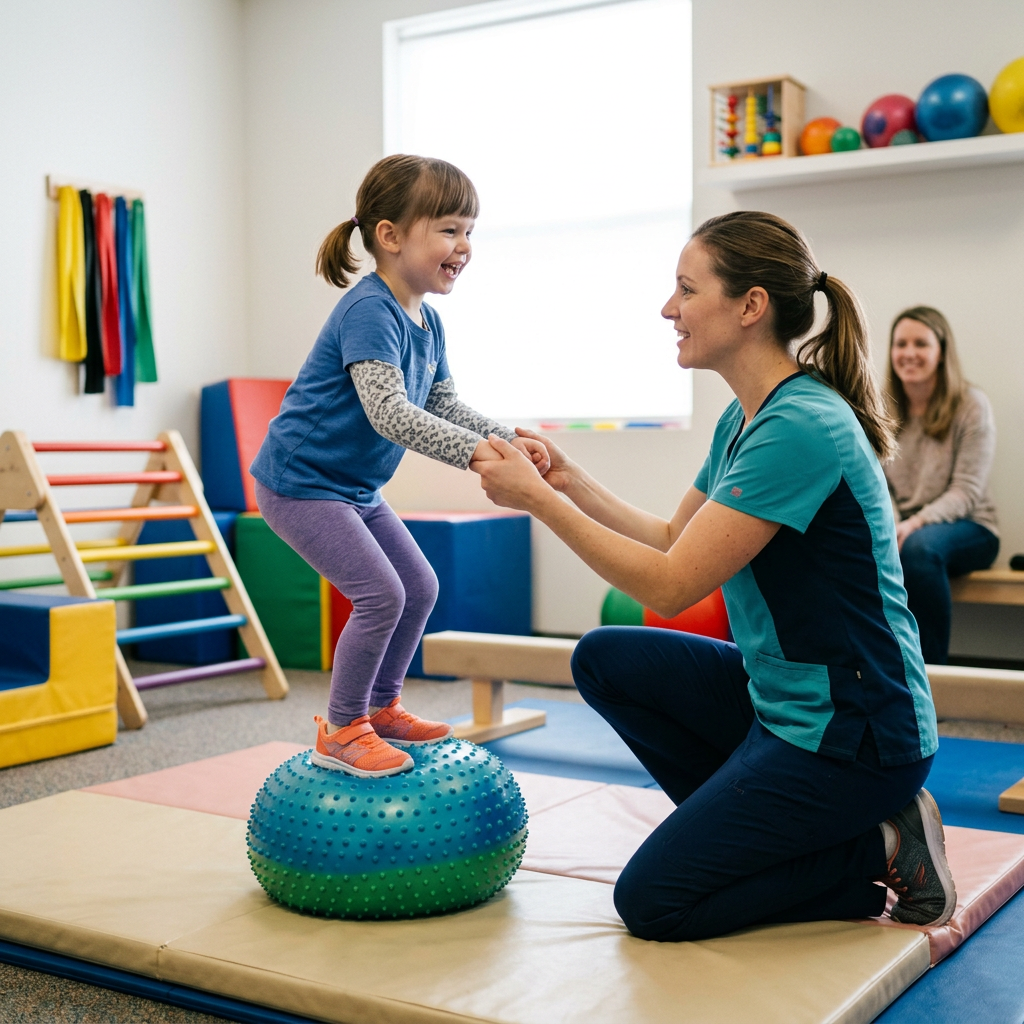
Maybe a pediatrician mentioned it at a checkup. Maybe a preschool teacher noticed your child struggles on the stairs while other kids run ahead. Maybe you have watched your own child and felt something you could not name, and then heard three words that made it real: pediatric physical therapy.
If you are reading this, you probably have more questions than answers. What does physical therapy even do for a child who is not injured? Will it feel clinical and stressful? Is this a sign something is seriously wrong? Those questions deserve calm, honest answers, not a wall of medical jargon.
This guide walks you through what pediatric physical therapy is, what usually happens at that first appointment, and how the process tends to unfold. It will not tell you whether your child needs it. That is a conversation for you and a qualified professional. But by the end, you should feel less like you are standing at the edge of something unknown.
Table of Content
Key Takeaways
- Pediatric physical therapy for kids helps children improve gross motor skills such as sitting, walking, running, balance, strength, and coordination. Therapy is usually play based and tailored to each child’s developmental needs.
- Pediatric physical therapy helps children build movement skills like balance, coordination, and strength, usually through play rather than formal exercise.
- It is not only for children recovering from injury. Many children start because of developmental differences in how they move.
- The first appointment is an evaluation: a conversation about your child plus observation of how they move, not a test your child can pass or fail.
- You are part of the team. Therapists rely on what you know about your child and often send simple activities home.
- Progress in physical therapy is usually gradual and built session by session, not a sudden leap.
What Is Pediatric Physical Therapy?
Pediatric physical therapy is a type of care focused on how children move. A pediatric physical therapist, sometimes called a PT, is trained to look at gross motor skills. Those are the whole body movement skills your child uses to sit, crawl, walk, run, jump, and climb.
The goal is not just to help a child move more smoothly. It is to help them take part in the ordinary things childhood is made of. Getting to the top of the slide. Keeping up on the playground. Carrying a lunch tray without it tipping. Movement is how children explore the world, so movement skills touch almost everything else.
Physical therapists work with one of the main types of therapy for kids. According to the APTA Academy of Pediatric Physical Therapy, care can begin with something as simple as a conversation to understand a child’s needs and a family’s concerns, followed by an examination of how the child moves within their everyday routines. Some children are babies with developmental delays. Some are older, at school age, and recovering from an injury or surgery. Some have a specific diagnosis, and some do not have a diagnosis at all yet.
One thing worth saying plainly: needing physical therapy is not a verdict on your parenting or a sign you missed something. Children develop at different paces and in different ways. Physical therapy is a form of support, not a punishment or a label.
Why Might a Child Be Referred?
Every child is different, and the reasons vary widely. Broadly, families tend to arrive at physical therapy through a few common doorways.
Some children are referred because of how they reached, or did not reach, early movement milestones. A parent or doctor may notice a child is taking longer to sit, crawl, or walk than expected. This does not automatically mean something is wrong, but it can be worth a professional look.
Other children are referred because of how they move rather than when. A child might walk on their toes, tire quickly, seem unusually clumsy, avoid physical play, or struggle with balance and coordination. Teachers often notice these patterns because they see children moving alongside their peers all day.
Still others come to physical therapy after an injury, surgery, or a diagnosed condition that affects movement. And some children are referred as part of a broader team, where a physical therapist works alongside other professionals like speech therapist.
If you are unsure whether your own child fits any of this, that uncertainty is normal, and it is exactly the kind of thing a qualified professional can help you sort through. This guide is meant to inform, not to help you assess your child on your own.
What Happens at the First Appointment?
The first visit is called an evaluation. For most families this is the moment the nerves peak, so it helps to know roughly what to expect.
An evaluation usually starts with a conversation. The therapist will want to hear from you. You know your child better than anyone, so questions about their history, their daily routines, and your specific concerns are a genuine part of the process, not small talk. It is worth jotting down your observations beforehand so you do not forget them in the moment.
Then comes the part that surprises many parents: a lot of it looks like playing. Rather than putting a child through drills, therapists watch how a child reaches for a toy, climbs onto a bench, or crosses the room. Underneath the play, the therapist is doing careful observation and using structured ways to understand how your child moves. What looks like fun to your child is, to a trained eye, rich information.
Practically speaking, a pediatric physical therapy evaluation often runs somewhere in the range of about 45 to 90 minutes, though this varies with a child’s age and attention span. Comfortable clothes your child can move freely in, and maybe a favorite snack or toy, tend to make the visit go more smoothly.
By the end, the therapist usually talks with you about what they observed and, if therapy is recommended, works with you to shape goals. Goal setting is meant to be collaborative. What matters most to your family, whether that is keeping up at recess or managing the stairs at home, is part of the conversation.
What Does Therapy Actually Look Like?
If your child begins therapy, the sessions themselves will probably look less like a hospital and more like a very intentional playroom.
Physical therapy for children leans heavily on play because play is how children learn and stay motivated. An obstacle course is really balance and coordination practice. Reaching games build strength. Climbing structures work on motor planning, which also overlaps with occupational therapy. A skilled therapist hides the work inside activities a child actually wants to do.
Sessions are also built around goals that you helped set. Rather than chasing a vague sense of improvement, therapists usually work toward specific, functional targets, then adjust as your child grows and changes. This is one reason progress can be hard to see week to week: the work is often incremental, aimed at a skill needing a little less help than it did last month.
Every child’s plan is different. The frequency, the length of each session, and how long therapy continues all depend on your individual child and are decided with the professionals involved. There is no single universal schedule, and comparing your child’s plan to another family’s is rarely useful.
Your Role as a Parent
It is easy to assume the therapist does the therapy and you sit in the waiting room. In pediatric physical therapy, that is usually not how it works.
Parents are often treated as part of the team. Much of a child’s day happens far from any clinic, so what you do at home matters. Therapists frequently share simple activities or a home program, weaving movement practice into routines you already have rather than adding a long homework block to your evening.
You are also your child’s advocate and translator. You are the one who notices a small new skill at the park, who flags when something feels off, and who carries information between the different people supporting your child. Keeping track of what you observe between sessions, in whatever simple way works for you, can make each appointment more useful.
None of this means the pressure is on you to become a therapist. It means the professional and the family work best as partners, each bringing something the other cannot.
A Gentle Word on Worry
If part of you is bracing for bad news, that is a very human response. But it helps to remember what physical therapy actually is: a support, a set of tools, a group of people whose entire job is to help your child move through the world a little more easily.
Many parents describe the strangest relief once they simply understand the process. Not because every question got answered, but because the unknown stopped being a blank space they filled with the worst stories they could imagine. You do not have to have it all figured out today. You only have to take the next small step, whatever that is for your family.
FAQ
Is pediatric physical therapy only for children with serious conditions? No. Children come to physical therapy for many reasons, from developmental differences in how they move to recovery after an injury. Some have a specific diagnosis and some do not. A referral is not a statement about how severe anything is; it is a step toward getting a professional’s view.
Will my child find physical therapy stressful? Pediatric physical therapy is usually designed around play precisely so children can stay comfortable and engaged. Therapists are trained to work at a child’s pace. Bringing a familiar toy or snack and dressing your child in comfortable clothes can help the first visit feel easier.
How long does a physical therapy session last? It varies. A first evaluation often takes somewhere around 45 to 90 minutes depending on your child’s age and attention. Regular sessions after that differ from child to child, and the schedule is set with the therapist based on your child’s specific goals.
Do I need to stay in the room during therapy? Often, yes, and that is a good thing. Parents are usually seen as part of the therapy team, offering information the therapist needs and learning activities to continue at home. Your involvement is one of the most valuable parts of the process.
How will I know if therapy is helping? Progress in physical therapy is frequently gradual rather than dramatic. It often shows up as a skill needing less help, appearing in more situations, or happening more often than before. Your therapist can help you understand what to look for, and simply tracking small changes yourself can make progress easier to see.
This article is for general information and is not medical advice. Every child is different. For guidance about your specific child, please talk with a qualified healthcare professional.

Leave a Reply