You booked the appointment. Now you are staring at the calendar, wondering what your child is actually walking into. A room full of toys? A stranger asking hard questions? Will they be okay?
If your picture of therapy is a couch and a notepad, play therapy looks nothing like that. For young children, play is the session. Instead of sitting across from a therapist answering questions, your child is more likely to be building a world in a sand tray, drawing a picture, or telling stories through toys.
The good news is that play therapy is usually much gentler than parents imagine. While every therapist has their own style, most sessions follow a similar rhythm that is designed to help children feel safe, understood, and free to express themselves. This guide walks you through what happens in child play therapy, from the first parent meeting to what takes place after the playroom door closes, so you know what to expect before your child walks in.
Key Takeaways
- Play therapy uses toys, art, stories, and games because these are the natural ways young children communicate.
- Most sessions last between 30 and 50 minutes and are guided by a trained therapist who follows the child’s lead rather than directing every activity.
- Parents play an important role throughout the therapy journey, even if they are not in the room during every session.
- Progress is often gradual and may first appear at home through small changes in behaviour, communication, or emotional regulation.
- You do not need to prepare your child with a long explanation. A simple, calm conversation is usually enough.
What Play Therapy Actually Is
Play therapy is a form of counselling designed around how children naturally communicate. While adults often process emotions by talking, young children are much more likely to express themselves through pretend play, drawing, storytelling, movement, and imagination. Rather than expecting a five year old to explain anxiety or sadness in words, a therapist creates a safe environment where those feelings can emerge naturally through play.
During a session, your child might build a scene in a sand tray, act out family relationships with dolls, paint freely, or invent stories using puppets and miniature figures. To an adult, it can look like ordinary play. To a trained play therapist or child psychologist, however, these activities provide valuable insight into how a child is experiencing the world around them.
That does not mean every drawing or toy has a hidden meaning. Therapists avoid making conclusions based on a single session or one piece of play. Instead, they look for patterns over time. A story that repeats, a character who is always left out, or a child who keeps returning to the same activity may gradually help the therapist understand what your child is trying to work through emotionally.
The idea behind play therapy is simple. Play is where children naturally feel comfortable expressing themselves, so it becomes the place where healing, learning, and emotional growth can happen. Your child is not being tricked into therapy. They are simply being met in the language they already know best.
Before the First Session
For many families, therapy begins before a child ever enters the playroom. Most therapists schedule an intake appointment with parents first, giving you an opportunity to explain what has been happening and what you hope therapy might achieve.
The conversation is usually much broader than the specific behaviour that brought you there. Rather than focusing only on tantrums, anxiety, or emotional outbursts, the therapist wants to understand your child’s everyday life and the environment they are growing up in. They may ask about:
- what prompted you to seek support
- what you have noticed at home or at school
- your child’s daily routines and relationships
- developmental and medical history
- recent life changes or stressful events
- what typically helps your child feel calm and safe
These questions are not about judging your parenting or looking for someone to blame. They help the therapist build a fuller picture of your child’s experiences so they can tailor support to your family’s needs.
You may also be asked to complete questionnaires about your child’s behaviour, emotions, or development. These provide a useful starting point and can help measure progress over time alongside your own observations.
The intake appointment is also your chance to ask questions. Every therapist works a little differently, so do not be afraid to ask about topics such as:
- how long each session lasts
- whether parents stay in the room
- how often therapy is recommended
- how progress is reviewed
- how parent updates are usually handled
A therapist who welcomes your questions and explains their approach clearly can help you feel more confident before therapy even begins.
If you are still preparing for this stage, our complete guide to preparing for child therapy explains how to choose a therapist, what to bring to your first appointment, and how to help your child feel ready before therapy begins.
Walking Into the Playroom
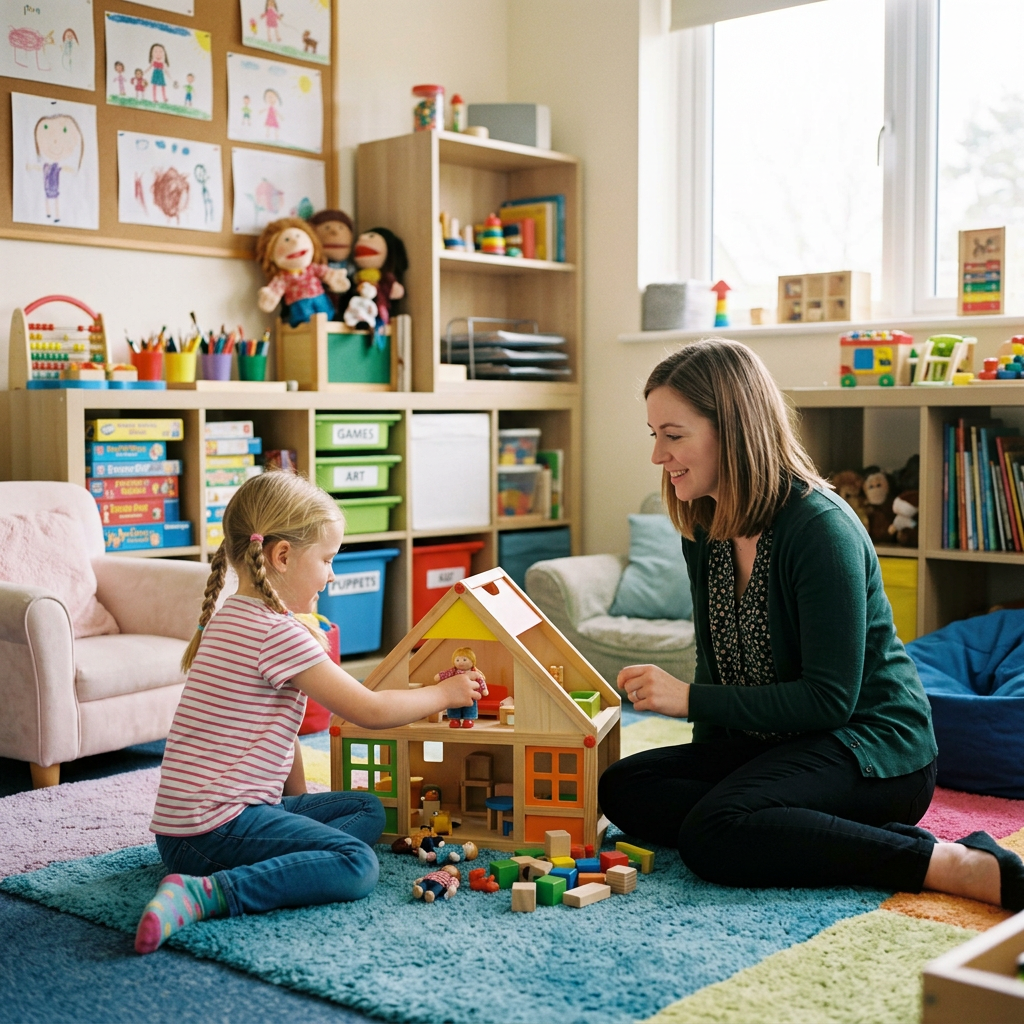
The playroom is often very different from what parents expect. Rather than looking like a doctor’s office or a classroom, it is designed to feel calm, welcoming, and emotionally safe. Everything in the room has been chosen with purpose, not simply to keep children entertained.
Although every therapist’s space is different, you will commonly see:
- dolls and family figures for exploring relationships
- puppets and miniature figures for storytelling
- a sand tray with miniature objects
- art supplies such as crayons, paint, and clay
- building blocks and pretend play toys
- books and soft toys
- sensory materials, such as kinetic sand or textured objects
Some children head straight for the art supplies. Others spend several sessions building the same imaginary world or returning to one favourite toy. There is no right or wrong way to use the playroom. Every child explores it differently, and those choices help the therapist understand what feels meaningful or comforting to them.
Nothing in the room is random. Each material offers another way for children to communicate thoughts, worries, and experiences that may be difficult to express in words.
If this is your child’s first visit, you may also find it helpful to read what to expect at your child’s first therapy appointment, which walks through everything from arriving at the clinic to saying goodbye after the session.
What Happens During a Session?
This is the question most parents want answered. Once the door closes, what actually happens in child play therapy?
The answer is usually much quieter than people imagine. Sessions are not tests, interviews, or lessons. Instead, they are carefully structured opportunities for children to explore their thoughts and emotions in ways that feel natural and safe.
The therapist follows your child’s lead
In most play therapy sessions, the child chooses what to play with and how to play. The therapist does not arrive with worksheets or a strict schedule. Instead, they observe where your child’s attention naturally goes and join them with curiosity, warmth, and gentle guidance.
This approach is intentional. When children lead the play, they often reveal what matters most to them without needing to explain it aloud. A child who has experienced a frightening event might replay a similar story several times using toys, gradually making sense of what happened. Another child may repeatedly separate and reunite toy families while processing change or loss.
Rather than directing the play, the therapist focuses on creating a relationship where your child feels accepted, understood, and emotionally safe. That sense of safety is often what allows deeper therapeutic work to happen over time.
The therapist reflects and names
As your child plays, the therapist listens carefully and makes simple observations about what they notice. They might say, “That character looks really worried,” or, “You worked hard to make sure everyone was safe.” These reflections are not meant to interrupt the play. Instead, they help children connect their experiences with words.
Over time, this process helps build emotional vocabulary. A child who once responded to frustration by shouting or throwing toys may gradually learn to recognise those feelings before they become overwhelming. Instead of communicating only through behaviour, they begin finding words for what is happening inside.
Learning to identify emotions is an important part of emotional regulation, and it develops gradually through many small moments like these. If you would like practical ways to support this skill at home, read our guide on helping your child name their feelings.
The pace is calm
Parents sometimes expect therapy to be filled with constant activities or obvious breakthroughs. In reality, many sessions unfold slowly. There may be quiet moments, long pauses, or several weeks where your child returns to the same game or story.
Although it can seem repetitive, this repetition often serves an important purpose. Children naturally revisit experiences until they begin to feel more manageable, and the therapist gives them the time and space to do that without rushing the process.
Most sessions last between 30 and 50 minutes. As the appointment comes to an end, the therapist usually helps your child wind down gradually rather than ending the play abruptly. This predictable routine helps children leave the session feeling calm and emotionally settled.
Will My Child Tell the Therapist Everything?
One concern many parents keep to themselves is whether they will know what happened after the session ends.
Children generally benefit from having a space where they can express themselves freely without worrying that every conversation or story will be repeated at home. At the same time, parents are an essential part of the therapy process, so therapists aim to balance your child’s privacy with your need to stay informed.
Rather than sharing every detail, therapists usually discuss broader themes they are noticing, how your child is responding to therapy, and practical strategies you can use between appointments. This allows your child to build trust with their therapist while ensuring you continue supporting their progress at home.
There is one important exception. If a therapist believes your child or someone else may be at risk of harm, they have a professional and ethical responsibility to act. They will explain what needs to happen next and involve you as appropriate.
Where You Fit In
Although your child is the one attending therapy, you remain one of the most important people in the process. Lasting progress rarely comes from one hour a week alone. It grows through the everyday interactions, routines, and relationships your child experiences at home.
Exactly how involved you are depends on your child’s age, needs, and the therapist’s approach. In some models, particularly with younger children, parents take part in sessions while the therapist offers guidance in real time. In others, the playroom becomes your child’s private therapeutic space, followed by a separate conversation where the therapist shares observations and practical recommendations.
Whatever the approach, your role extends well beyond the therapy room. Therapists often encourage parents to support progress by:
- setting aside regular child led playtime
- noticing situations that trigger strong emotions
- celebrating small signs of progress
- practising strategies discussed during parent updates
- keeping track of questions or changes between sessions
You may also wonder what to say after an appointment. Rather than asking lots of questions about what happened, many therapists recommend keeping your response simple. A comment such as, “I’m glad you went today,” gives your child the freedom to share if they want to, while also protecting the trusting relationship they are building with their therapist.
What If My Child Doesn’t Want to Play?
Not every child walks into the playroom and immediately starts exploring. Some children stay close to the door, sit quietly, or spend the first few minutes looking around before touching anything. Others may seem more interested in chatting with the therapist than playing, while some appear hesitant to engage at all.
If this happens, it does not mean therapy is not working.
Like any new relationship, trust takes time to build. Before children can explore difficult emotions, they need to feel safe with the person sitting beside them. A skilled play therapist understands this and will never force a child to play, talk, or participate before they are ready.
Instead, the therapist follows your child’s pace. During the first few sessions, they may simply focus on getting to know your child through conversation, observation, or shared play. For some children, becoming comfortable enough to enter the room confidently is meaningful progress in itself.
Every child adjusts differently. Some settle in during the first visit, while others need several sessions before they begin expressing themselves more freely. Both experiences are completely normal.
What Progress Looks Like
One of the biggest surprises for parents is that progress in play therapy is rarely dramatic. There is usually no single session where everything suddenly changes. Instead, growth tends to happen quietly, one small step at a time.
In fact, the first signs of progress often appear at home rather than in the therapy room. You may notice subtle changes that are easy to overlook unless you are paying attention.
For example, your child might begin to:
- recover more quickly after becoming upset
- express feelings using words instead of behaviour
- sleep more peacefully
- cope better with changes in routine
- play more creatively or independently
- show greater confidence in everyday situations
- become more willing to try new things
- seek comfort or support instead of withdrawing
These changes may seem small on their own, but together they often signal meaningful emotional growth.
It is also common for progress to feel uneven. Some weeks your child may seem calmer and more confident, while other weeks old behaviours return. That does not necessarily mean therapy is moving backwards.
As children begin processing difficult experiences, they sometimes become more expressive before things settle down again. They may test new coping skills, revisit old worries through play, or show emotions they previously kept hidden. This can feel unsettling for parents, but it is often a normal part of the therapeutic process.
If you ever feel unsure about what you are seeing, bring those observations to your therapist. What happens between sessions is just as valuable as what happens during them, and your perspective helps the therapist understand how your child is functioning in everyday life.
Every child moves at their own pace, and there is no universal timeline for therapy. Some children attend for a few months, while others benefit from longer term support depending on their needs and goals. Your therapist is the best person to discuss what is realistic for your child’s individual situation.
How to Prepare Your Child
Parents often worry about saying the perfect thing before the first appointment. Fortunately, you do not need a carefully rehearsed speech. In fact, keeping your explanation simple is usually the best approach.
You might say something like:
“We’re going to visit someone whose job is helping children with big feelings. There will be lots of toys, and you can play while they get to know you.”
For younger children, that is often all they need to hear.
It also helps to focus on what therapy is, rather than what it is for. Avoid saying things like, “You’re going because you’ve been naughty,” or, “The therapist is going to fix your behaviour.” Even if said with good intentions, these messages can make children feel as though something is wrong with them.
Instead, try to frame therapy as another form of support, much like visiting a doctor when your body needs help or seeing a teacher when you are learning something new.
A few simple things can also make the first visit feel less overwhelming:
- tell your child about the appointment a day or two beforehand, rather than weeks in advance
- answer questions honestly without giving more information than they ask for
- keep your own tone calm and reassuring
- allow extra time so you are not rushing to the appointment
- bring along a favourite comfort item if the therapist says it is appropriate
Children often take emotional cues from the adults around them. If you treat therapy as a safe and ordinary part of getting support, your child is more likely to feel that way too.
A Quiet Note for You
Watching your child begin therapy can bring up emotions you were not expecting.
You might feel relieved that help is finally here. You might worry about whether you made the right decision. You may even wonder if you should have reached out sooner.
Many parents experience all of those feelings at once.
If that sounds familiar, you are not alone.
Parenting often comes with an invisible pressure to have all the answers. When your child is struggling, it is easy to question yourself or wonder whether you could have prevented things from becoming difficult.
The truth is that asking for help is not a sign you have failed your child. It is often one of the most protective things you can do.
By reaching out, you are giving your child another safe adult who wants to understand them, support them, and help them develop skills they can carry into the future. You are also giving yourself the opportunity to learn alongside them, because therapy is rarely just about what happens during one hour each week. It is about strengthening the relationships and routines that support your child every day.
That matters more than you may realise.
FAQ
What happens in child play therapy during a typical session?
Most sessions begin with your child entering a playroom filled with carefully selected toys and creative materials. The therapist follows your child’s lead, observing themes in their play, reflecting emotions, and supporting emotional development in ways that feel natural for their age. Sessions usually last between 30 and 50 minutes.
Is play therapy real therapy or just playing?
Play therapy is a recognised form of counselling delivered by trained professionals. Rather than relying on conversation alone, therapists use play because it is one of the primary ways young children communicate and process experiences.
How long does play therapy take to work?
Every child is different. Some families notice small changes within a few weeks, while others benefit from longer term therapy. The length of treatment depends on your child’s needs, goals, and the concerns being addressed.
How often do children attend play therapy?
Many children attend sessions once a week, although your therapist may recommend a different schedule depending on your child’s circumstances and the type of therapy being used.
Should I stay in the room during my child’s session?
It depends on the therapist’s approach and your child’s needs. Some therapists involve parents directly in sessions, while others work with the child individually before meeting with parents afterwards to discuss progress and recommendations.
What toys are used in play therapy?
Play therapists often use dolls, puppets, sand trays, miniature figures, building blocks, art supplies, pretend play materials, sensory toys, and books. Each item gives children another way to communicate feelings and experiences that may be difficult to express with words alone.
How do I know if play therapy is helping?
Progress often appears in everyday life before it becomes obvious during sessions. Parents may notice improvements in emotional regulation, communication, confidence, sleep, flexibility, or relationships at home and school.
How do I explain play therapy to my child?
Keep your explanation short, honest, and reassuring. Tell your child they are visiting a kind grown up whose job is helping children with big feelings, and that there will be toys and activities to explore. Your calm attitude will often reassure them more than a long explanation.
Walking Through This Journey With Your Child?
Therapy is not just about what happens during one session each week. It is also about the conversations you have at home, the small wins you celebrate, and the questions you want to remember for the next parent update.
Keeping all of that in your head can quickly become overwhelming.
My Child’s Therapy Journey is a printable therapy binder designed to help you keep everything in one place. Use it to organise session notes, track progress over time, write down questions for your therapist, and celebrate the small milestones that are easy to miss in the middle of everyday life.
[Get the binder →]

Leave a Reply