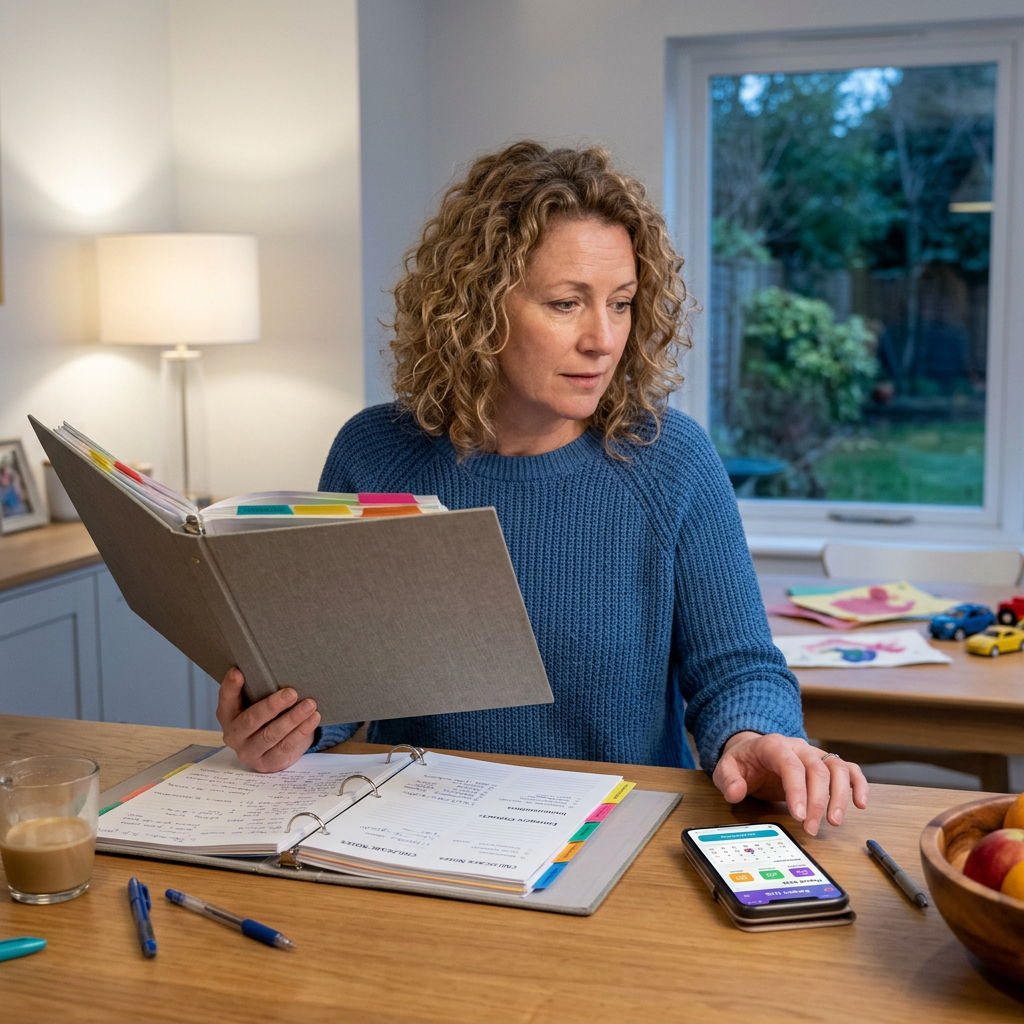
You downloaded the app, logged your child’s therapy homework for a few days, and then life got busy.
Now you’re wondering whether a paper binder would have been easier to stick with.
If that sounds familiar, you’re not alone.
Choosing between a therapy tracking app vs paper is one of the first practical decisions many parents make after therapy begins. The right system can help you remember home practice, spot patterns, and make therapy sessions more productive. The wrong one often gets abandoned after a few weeks.
This guide compares both options honestly. You’ll learn where therapy apps work well, why many parents still prefer paper, and which system is easiest to use consistently and share with your child’s therapist.
Therapy Tracking App vs Paper: Which Is Better?
For most families, a paper therapy binder is the more reliable choice. While therapy apps are convenient for reminders and quick notes, paper is often easier to use consistently, simpler to review during appointments, and less distracting. Many parents use an app for reminders but keep a paper binder as their main therapy record.
Key Takeaways
- The best therapy tracker is the one you use consistently every week.
- Paper therapy binders remove common barriers like logins, battery life, and notifications.
- Therapy apps are ideal for reminders and recording quick notes while you’re away from home.
- Paper records are easier to review and discuss during therapy sessions.
- Many families combine both by using an app for reminders and a binder for long-term documentation.
Why This Choice Matters
Tracking your child’s therapy progress might seem like a small administrative task. It isn’t.
The notes you keep become the shared record between you, your child, and the professionals supporting their development. Whether you use a therapy binder, therapy journal, therapy notebook, or digital therapy tracker, the goal is the same: to create one reliable place where important information doesn’t get lost.
Without a consistent record, it’s easy to forget the details that matter.
You might remember your child struggled with home practice, but not which activity caused the frustration. You may notice a new skill emerging, but forget exactly when it first appeared.
Those small details often shape what happens in the next therapy session.
When you arrive with clear notes, your therapist spends less time piecing together the previous week and more time planning the next steps. Professional bodies like the American Speech-Language-Hearing Association point to family involvement between sessions as one of the strongest drivers of a child’s progress, and a record is how that involvement stays organised.
The question, then, isn’t which tool has the most features. It’s which one helps you show up prepared, week after week.
The Benefits of a Therapy Tracking App
A therapy tracking app has some clear advantages, which is why many parents choose one first.
Because your phone is usually with you, it’s easy to record information wherever you are. Whether you’ve just left a therapy session or noticed something during home practice, you can quickly capture it before you forget.
Many therapy apps also include helpful features such as:
- Reminders for home practice
- Quick note-taking
- Progress charts and summaries
- Digital storage for therapy records
- Access across multiple devices
For families who already use digital calendars and reminders, an app can fit naturally into their daily routine.
Another benefit is portability. Instead of carrying a folder or binder, your therapy notes stay on your phone, ready whenever you need them.
For some parents, that convenience makes a therapy tracking app the right choice.
The Hidden Challenges of Therapy Apps
Convenience is important, but so is consistency. Every time you want to record something, there are several small steps:
- Unlock your phone
- Find the app
- Wait for it to load
- Open the correct page
- Type your notes
Each step takes only a few seconds. Together, however, they create enough friction that it’s easy to think, “I’ll do it later.”
Later often becomes tomorrow. Tomorrow becomes next week. This is not a failure of willpower. Research on home practice consistently finds that busy, unpredictable family life is the main reason planned practice does not happen, which is exactly why removing friction matters more than adding features.
Phones also compete for your attention. You open the app intending to record one observation, but instead notice a text message, a work email, a social media notification, or a news alert. Before long, the simple task of recording your child’s progress has been interrupted.
There is another consideration too.
Digital tools change over time. Some introduce subscriptions, remove features, or eventually stop receiving updates. While many apps remain reliable for years, it’s worth thinking about how easily you could access your child’s therapy record if you ever wanted to switch to another system.
None of this means therapy apps are a poor choice.
It simply explains why many parents download an app with good intentions but struggle to keep using it consistently.
The best therapy tracker isn’t necessarily the one with the most features. It’s the one you’ll still be using months from now.
The Benefits of a Paper Therapy Binder
If you are comparing a therapy tracking app vs paper, it is easy to assume that paper is the less convenient option.
In reality, its simplicity is often its biggest advantage.
A paper therapy binder removes many of the small barriers that make it difficult to keep tracking consistently. There are no passwords, software updates, or loading screens. You simply open the binder and write.
For busy parents, that matters. A paper therapy binder is:
- Always ready to use. There is no charging, syncing, or internet connection required.
- Easy to keep visible. Leave it on the kitchen counter, in your child’s therapy bag, or near the front door so it naturally reminds you to use it.
- Free from distractions. There are no emails, text messages, or social media notifications competing for your attention.
- Reliable for the long term. Your child’s therapy record is not dependent on an app, subscription, or software update.
Most importantly, paper keeps your attention where it belongs, on your child rather than on the technology you are using.
Many parents find that writing a few notes after each therapy session quickly becomes part of their weekly routine because there is almost nothing preventing them from getting started.
Therapy Tracking App vs Paper: Which Helps Parents Stay Consistent?
When comparing a therapy tracking app vs paper, consistency matters much more than features.
The most advanced app cannot help if you stop opening it after a few weeks. Likewise, the most beautifully designed therapy binder is only useful if you actually use it.
The goal is not to find the smartest tracking tool. It is to choose the one you will realistically continue using through busy school terms, holidays, illnesses, and everyday family life.
For many parents, paper quietly wins because it removes friction. That same small friction from opening an app, unlocking, waiting, and navigating through screens, adds up until it’s easy to think, “I will do it later.” And later often becomes next week.
Paper asks much less of you. It is already there. It is already open. It is ready whenever you are.
That simplicity makes it easier to build a lasting habit, especially when you are already balancing therapy appointments, school, work, and family responsibilities.
Why Simple, Consistent Records Work Well in Sessions
Parents often ask whether therapists prefer an app or a paper binder.
In most cases, the format matters less than the quality of the information. What tends to help during a session are records that are consistent, easy to understand, simple to review together, and helpful for identifying patterns over time.
A paper therapy binder naturally supports this type of collaboration. During an appointment, you and your therapist can:
- Review several weeks of notes together.
- Compare progress over time.
- Highlight recurring challenges.
- Circle important milestones.
- Add new observations during the discussion.
Instead of spending valuable session time trying to remember what happened, you can focus on planning what happens next.
Consistency tip A simple therapy record completed every week is usually more valuable than a detailed tracking system used only occasionally. Consistent notes give a clearer picture of your child’s progress than perfect notes written once in a while.
Therapy Tracking App vs Paper During Therapy Sessions
The difference between paper and digital often becomes most noticeable during therapy appointments.
Imagine your therapist asks, “How did home practice go this week?”
With a paper therapy binder, you simply open to the relevant page. Together, you can review several weeks of notes, compare today’s progress with previous sessions, point to important observations, highlight recurring behaviours, and write down next week’s home practice before leaving. The binder becomes a shared working document that both of you can see at the same time.
With a therapy tracking app, you usually need to unlock your phone, open the app, scroll through multiple entries, switch between different screens, and hand your phone to the therapist if they want to read your notes. This approach certainly works, but it is rarely as comfortable as reviewing paper together.
Paper also makes it easier to share information with everyone supporting your child. You can bring it to every therapy appointment, photocopy pages for another therapist, share observations with teachers, take it to medical appointments, and hand the complete therapy record to a new provider during transitions.
Nothing is hidden behind an account or locked inside an app.
Therapy Tracking App vs Paper: Side by Side Comparison
| Feature | Paper Therapy Binder | Therapy Tracking App |
|---|---|---|
| Weekly consistency | Easy to maintain | Depends on remembering to open the app |
| Reminders | No | Yes |
| Quick notes away from home | Good | Excellent |
| Easy to review during sessions | Excellent | Fair |
| Distraction free | Yes | No |
| Long term therapy record | Excellent | Depends on the app |
| Storage | Physical binder | Digital |
Do You Have to Choose Between a Therapy Tracking App and Paper?
Not at all.
When comparing a therapy tracking app vs paper, many parents assume they have to choose one or the other. In reality, the two tools can work well together.
A therapy tracking app is useful for setting reminders for home practice, recording quick observations while you are away from home, and capturing ideas before you forget them.
A paper therapy binder is often better for keeping your complete therapy record in one place, reviewing progress over several weeks or months, sharing notes with your child’s therapist, and bringing to appointments.
This approach allows each tool to do what it does best. Your phone helps you remember. Your binder becomes the long term record of your child’s therapy journey.
For many families, this combination feels practical without becoming overwhelming.
How to Combine a Therapy App and a Paper Binder
If you want the convenience of digital reminders without losing the benefits of paper, keep the system simple.
You might use your therapy tracking app to remind you to complete home practice, record a quick observation after therapy, or save questions that come to mind during the day.
Then, once or twice a week, transfer the important information into your paper therapy binder. Your binder becomes the place where you organise therapy goals, weekly progress, home practice notes, questions for the therapist, milestones, and session summaries.
Instead of maintaining two complete systems, you are simply using each one for its strongest purpose. This approach also means your child’s complete therapy history stays together in one place.
How to Make Your Paper Therapy Binder Easy to Maintain
A therapy binder only works if it is simple enough to use consistently. Many parents stop tracking because they create a system that asks too much of them.
Your binder does not need dozens of complicated pages. It needs pages you will actually complete.
Keep it simple. One weekly progress page is often more useful than several detailed worksheets that never get used. If filling in the binder feels like homework, it becomes much harder to stay consistent.
Keep it visible. Store the binder somewhere you naturally see every day, such as the kitchen counter, your child’s therapy bag, your desk, or near the front door. A visible binder acts as its own reminder.
Keep the format consistent. Use the same page layout every week. When you always know where to record home practice, wins, challenges, questions, and therapist recommendations, tracking becomes a routine rather than a decision.
Keep it ready for appointments. Bring your therapy binder to every session so you can review previous notes together, record new recommendations immediately, and leave with a clear plan for home practice.
The less preparation your system requires, the more likely you are to keep using it.
Frequently Asked Questions
Is a therapy tracking app better than paper for busy parents?
Not necessarily. Many busy parents find that a paper therapy binder is easier to maintain because it removes common barriers such as logging in, charging a device, or navigating through an app. The best system is the one you will continue using consistently.
Can I bring a paper therapy binder to appointments?
Yes. A paper binder allows you to compare several weeks of notes together, highlight patterns, and record new recommendations during the session. If you are still preparing for your first therapy appointment, bringing a simple record from day one makes the early sessions easier.
What should I record after each therapy session?
You do not need lengthy notes. Recording a few key details is usually enough: what your child practised, strategies the therapist recommended, home activities for the week, questions you want to ask next time, and any new achievements or challenges. Consistent short notes are usually more valuable than detailed notes written only occasionally.
Is paper more secure than a therapy tracking app?
Both have advantages. Paper cannot be affected by software updates, forgotten passwords, or discontinued apps. Digital tools may offer password protection and cloud backup, but access depends on the app you use. Choose the option that makes you feel most confident about maintaining your child’s therapy record over time.
Which system should I choose?
If you are choosing only one, a paper therapy binder is often the easier system to maintain over the long term. If you like digital reminders, consider using both. Use your phone to remind you what to do. Use your binder to remember what happened.
Ready to Start a Therapy Record You Will Actually Keep?
The hardest part of tracking your child’s therapy progress is not knowing what to write. It is finding a system that fits into real family life.
My Child’s Therapy Journey was designed to do exactly that. Inside the binder, you can keep everything in one organised place, including therapy goals, weekly progress notes, home practice activities, therapist recommendations, questions for upcoming appointments, and important milestones.
Instead of searching through notebooks, text messages, or phone notes, you’ll have one complete record that grows with your child and is ready to bring to every therapy session.
Coming soon: My Child’s Therapy Journey printable therapy binder. Join the waitlist to be the first to know when it launches.

Leave a Reply