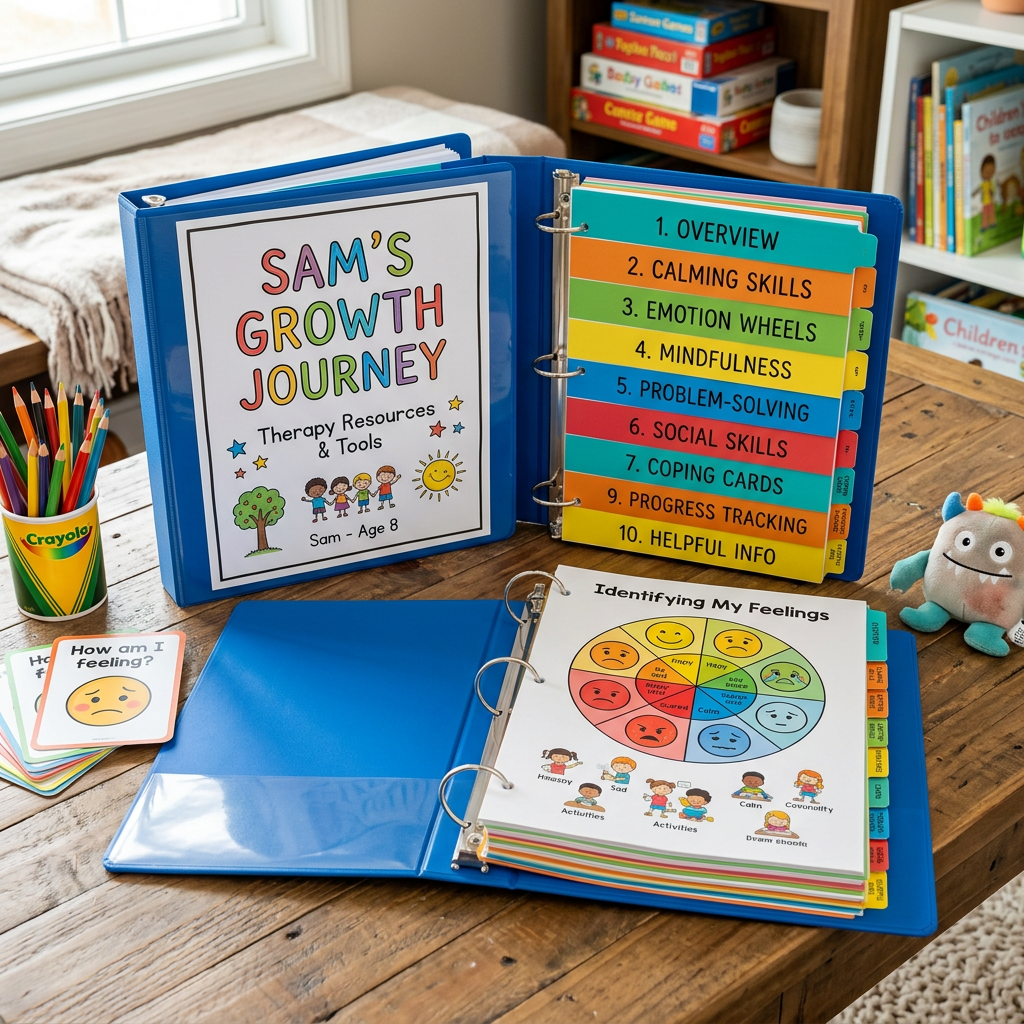
Keeping track of your child’s therapy can quickly become overwhelming. You may have session notes in your phone, therapy reports in different folders, questions you want to ask at the next appointment, and recommendations written down on random pieces of paper.
A child therapy binder can bring all of this information together in one organised place. But knowing what to put inside can be just as confusing. Should you keep every session note? Do you need to track progress every day? What about assessment reports, home activities, or questions for the therapist?
The good news is that you don’t need to document everything. A useful therapy binder should make it easier to understand your child’s therapy journey, keep important information accessible, and prepare for conversations with their care team.
This guide will walk you through what to include in a child therapy binder, how to organise the information, and which sections are most useful for parents.
What to Put in a Child Therapy Binder
A child therapy binder should contain the information that helps you understand your child’s current therapy, remember important recommendations, and communicate effectively with their care team. The exact sections will depend on your child’s needs and the types of therapy they receive.
Most parents can start with a few essential sections and add others as needed.
Key Takeaways
- Start with basic information about your child and their therapists.
- Keep current therapy goals and session notes together.
- Record observations and small changes you notice between sessions.
- Keep questions and home practice recommendations in one place.
- Store important reports and documents where they are easy to find.
- Keep your binder simple enough that you can maintain it regularly.
Why a Child Therapy Binder Can Be Helpful
When your child attends regular therapy, information can quickly become scattered across different places. You may remember something a therapist mentioned during an appointment but forget the details a few weeks later. You may also notice a change at home that seems important but struggle to remember when it started.
A therapy binder gives you one place to keep the information that matters.
It can help you:
- Remember what you discussed during appointments.
- Keep track of current therapy goals.
- Record observations from everyday life.
- Prepare questions before the next session.
- Find important reports and recommendations.
- See changes over time.
The goal is not to create a detailed record of everything your child does. Instead, it should help you see the bigger picture of your child’s therapy journey.
Start With Basic Information About Your Child
The first section of your binder can contain simple information that you may need to access regularly.
You might include:
- Your child’s name
- Date of birth
- Current school or grade
- Relevant contact information
- Current therapists or providers
- Types of therapy your child receives
- Important dates
Keeping this information together can be particularly useful when your child works with more than one professional.
You don’t need to include every detail of your child’s medical or educational history. Focus on information that is useful for organising their current therapy journey.
Keep Your Child’s Therapist Information Together
If your child sees multiple therapists, it can be difficult to remember who is working on which area.
Create a simple section for provider information, including:
- Therapist’s name
- Type of therapy
- Clinic or practice
- Contact information
- Appointment schedule
- Other relevant notes
For example, your child may receive occupational therapy and speech therapy at different clinics. Keeping both providers in one place can make it easier to understand the different types of support your child receives.
Record Current Therapy Goals
Therapy goals are one of the most useful things to keep in your binder.
Your child may have several goals at the same time, particularly if they receive more than one type of therapy. Having them written down gives you a simple reference point when thinking about what you are currently working on.
You might record:
- The current goal
- Which therapy it relates to
- When the goal was introduced
- Recommendations from the therapist
- Relevant updates
- When the goal is reviewed
Try to use language that makes sense to you.
You do not need to rewrite a therapist’s goals into complicated clinical language. The purpose is to help you understand what your child is currently working towards.
Keep a Simple Session Log
You don’t need to write down everything that happens during every therapy appointment.
A simple session log can be enough to help you remember the important information.
For each session, you might record:
- Date
- Type of therapy
- Main focus
- What the therapist shared
- Recommendations for home
- Questions or follow-ups
For example, instead of writing a detailed description of the entire session, you might simply note that the therapist introduced a new strategy and recommended trying it during a particular daily routine.
Short notes are often easier to maintain than detailed records.
Track What You Notice at Home
Therapy sessions only show one part of your child’s experience. Parents may notice different things because they see their child in everyday environments such as home, school, or social situations.
Your binder can give you a place to record these observations.
You might notice changes in:
- Communication
- Motor skills
- Social interaction
- Emotional regulation
- Daily routines
- Independence
- Participation in activities
Try to describe what you actually observe rather than interpreting what the observation means.
For example, instead of writing:
“My child has better emotional regulation.”
you could write:
“After becoming frustrated with the activity, my child used the strategy we practised and returned to the activity after a few minutes.”
Specific observations can give you useful information to discuss with your child’s therapist.
Keep Track of Small Wins
Progress does not always look like a major milestone.
Sometimes it is something very small, such as:
- Trying a new activity
- Needing fewer prompts
- Completing part of a routine independently
- Using a new communication strategy
- Staying with an activity for longer
- Recovering from frustration more easily
A small-wins section gives you somewhere to capture these moments.
It can also help you notice changes that might otherwise be easy to forget, especially when progress happens gradually.
Create a Section for Home Practice
Therapists may recommend activities or strategies for you to try between sessions.
Keeping these recommendations in one place can make them easier to remember.
You might include:
- Activity or strategy
- What the therapist recommended
- When to try it
- What you noticed
- Questions that came up
This does not need to become a complicated daily homework tracker.
The purpose is simply to help you remember what your therapist suggested and what happened when you tried it.
Keep a Running List of Questions
Questions often come up between appointments.
You might notice something at home and think, “I should ask the therapist about this.” By the time the next appointment arrives, however, it can be easy to forget.
A dedicated question section solves this problem.
You could write down questions such as:
- Is this something we should keep observing?
- Is there another strategy we could try at home?
- Should we continue with this activity?
- What would progress look like for this goal?
- When should we review this goal?
You can then bring your questions to the next appointment instead of trying to remember them at the last minute.
Organise Important Reports and Documents
Your child’s therapy journey may include reports, assessments, summaries, and recommendations.
Keeping these documents together makes it easier to find information when you need it.
Depending on your child’s circumstances, you may want to keep:
- Initial evaluations
- Progress reports
- Therapy summaries
- Assessment results
- Recommendations
- Relevant school reports
- Other documents provided by professionals
If you use a physical binder, dividers or document pockets can help keep paperwork organised.
If you prefer digital records, you can create a simple document index showing where each file is stored.
Include Important Dates and Milestones
A simple timeline can help you understand how your child’s therapy has developed over time.
You might record:
- First therapy appointment
- Evaluation dates
- When a new therapy started
- Major changes in services
- Goal review dates
- Important follow-up appointments
You don’t need to record every event.
Focus on dates that help you understand changes in your child’s support and therapy goals.
What Should You Leave Out of a Therapy Binder?
It can be tempting to document everything when you are trying to support your child.
But more information does not necessarily make a therapy binder more useful.
You probably don’t need to include:
- Every minor behaviour you notice
- Detailed interpretations of your child’s behaviour
- Your own clinical conclusions
- Complicated scoring systems you don’t understand
- Duplicate copies of documents
- Information you are unlikely to review again
Your role as a parent is to observe, document relevant information, and communicate with your child’s care team. Clinical assessment and diagnosis should remain with qualified professionals.
How to Organise Your Child’s Therapy Binder
There is no single structure that works for every family. However, a simple system can make the binder easier to use.
You could organise it into sections such as:
| Section | What to Include |
|---|---|
| Quick Reference | Child information and provider contacts |
| Current Therapy | Goals, session notes and recommendations |
| Progress | Parent observations and small wins |
| Home Practice | Strategies and activities recommended by therapists |
| Questions | Topics to discuss at upcoming appointments |
| Records | Reports, assessments and important documents |
You can add or remove sections depending on what your family actually needs.
The best therapy binder is not necessarily the most detailed one. It is the one you can realistically keep using.
How Often Should You Update a Therapy Binder?
You don’t need to spend hours updating your binder every week.
For many families, a few minutes after each therapy session can be enough to capture the most important information.
You might also review your binder once a month to:
- Review current goals.
- Look back at recent observations.
- Add questions for upcoming appointments.
- Move outdated information into an archive.
- Check that important documents are easy to find.
Consistency is more important than perfection.
A simple system that you actually use is much more valuable than a detailed binder that becomes too difficult to maintain.
Physical Binder or Digital Tracker: Which Is Better?
Both options can work, depending on how your family prefers to organise information.
A physical binder may work well if you:
- Prefer writing by hand.
- Receive paper documents.
- Bring information to therapy appointments.
- Like having everything in one physical place.
A digital tracker may be more convenient if you:
- Prefer typing.
- Have many digital documents.
- Want to access information from different devices.
- Like being able to search your notes.
You can also combine the two.
For example, you might keep important reports digitally while using a physical binder for current goals, observations, session notes, and questions.
There is no need to choose the most sophisticated system. Choose the one that fits naturally into your family’s routine.
Frequently Asked Questions
What should I put in my child’s therapy binder?
Start with basic information, therapist contacts, current therapy goals, session notes, parent observations, home practice recommendations, questions for therapists, and important reports or documents. You can add other sections based on your child’s individual needs.
Do I need to record every therapy session?
Not necessarily. A simple record of the date, main focus, important recommendations, and follow-up questions may be enough. The goal is to capture useful information rather than document every detail.
Should I track my child’s progress every day?
You don’t have to. Some parents find it useful to record observations when something meaningful happens rather than following a strict daily schedule. Choose a method that you can maintain consistently.
Can I use one binder for multiple types of therapy?
Yes. A single binder can be useful when your child receives several types of therapy. Using separate sections for different therapies can help you keep information organised while still seeing the bigger picture.
What if my child’s therapy goals change?
That is normal. Therapy goals can change as your child develops new skills or as different priorities emerge. Keep current goals easy to access and move older goals into an archive rather than removing them completely.
Final Thoughts
A child therapy binder doesn’t need to contain everything.
It simply needs to contain the information that helps you stay organised, notice meaningful changes, remember important recommendations, and have more useful conversations with your child’s care team.
Start with the essentials: your child’s current goals, session notes, observations, questions, and important documents. As you use the binder, you’ll naturally discover which sections are helpful and which ones you don’t need.
The goal is not to create a perfect record of your child’s therapy.
It is to create a simple system that helps you stay connected to their journey.
Create Your Own Child Therapy Binder
Building a therapy binder from scratch can take time, especially when you are already managing appointments, paperwork, and everyday family life.
The My Child’s Therapy Journey Parent Therapy Binder from Attunement Family gives you a structured place to organise therapy information, record observations, keep session notes, and prepare for conversations with your child’s care team.
It is designed to be flexible across different types of therapy, so you can use the sections that make sense for your family.
Explore the My Child’s Therapy Journey Parent Therapy Binder

Leave a Reply