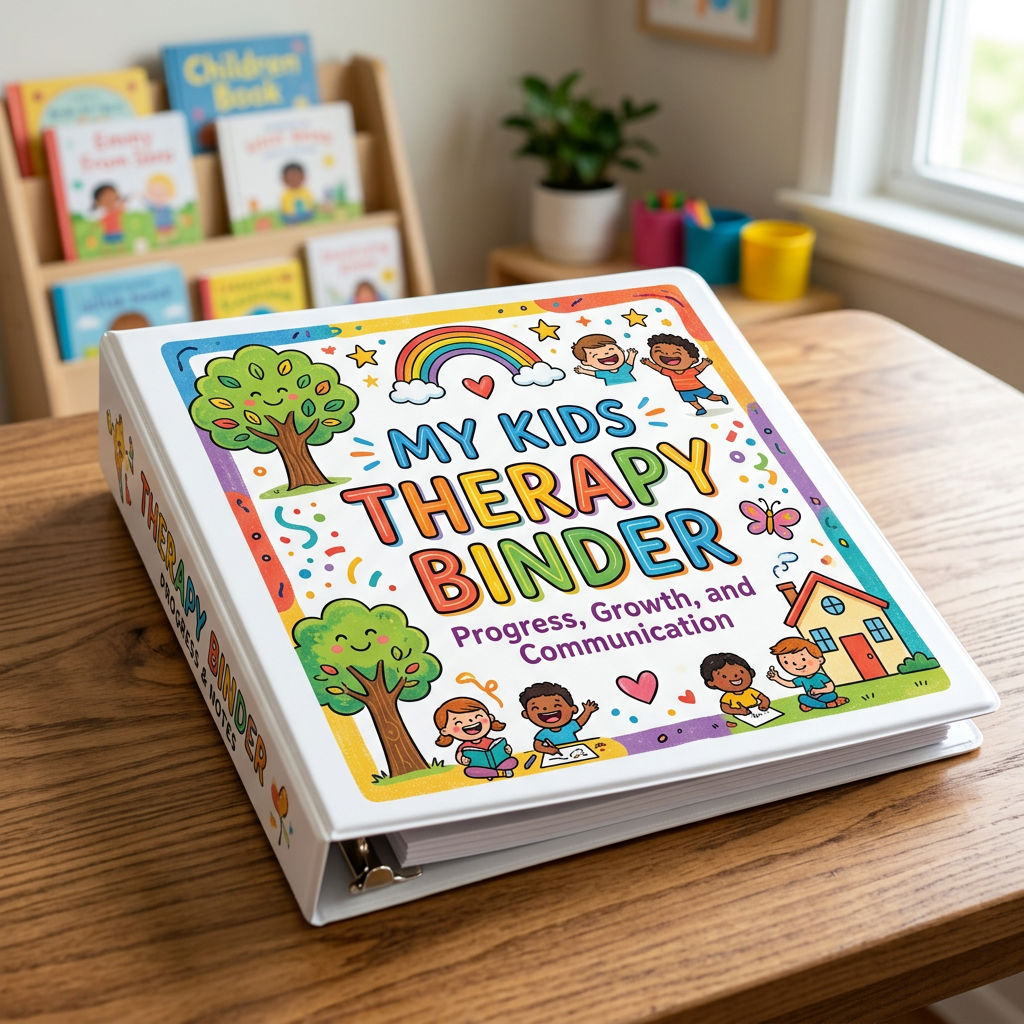
Wondering exactly what is included in the My Child’s Therapy Journey printable binder before you buy? This page walks through every section and every page type, plus the full specs.
Inside the binder you will find printable pages across five working sections: a Dashboard that holds the big picture, tracking pages for daily practice and sessions, reflection pages that make slow progress visible, organization tools for paperwork and school communication, and a plain-language reference section. By the end of this walkthrough you will know exactly what you are getting, and whether it fits your family.
Key Takeaways
- The binder is organized around five jobs: see the big picture, track what happens, reflect on progress, organize the paperwork, and understand the terms.
- Every page is designed for real weeks, including the messy ones. The Daily Log has a Rest Day option for a reason.
- It works for any type of support your child receives: speech, OT, physical therapy, play therapy, psychology, or several at once. It is a printable PDF, not an app.
- If you prefer typing on your phone, this is probably not your tool, and that is okay.
- One purchase covers your whole journey. Print only what you need, as often as you need it, for as many children as you have.
The binder at a glance
| Section | Pages inside | What it does for you |
|---|---|---|
| Dashboard | Child profile, support team contacts, current goals, weekly schedule | One page to open at every appointment |
| Tracking | Daily Log, Session Notes | Record what happens without writing much |
| Reflection | Weekly Reflection, Wins Wall | See progress you would otherwise miss |
| Organization | Documents Checklist, Communication Log | Tame the paperwork and the email threads |
| Reference | Therapy terminology guide | Understand reports without a dictionary |
Now the same walkthrough in detail, page by page.
Why show everything
Most digital products hide behind three preview images. You buy, you download, and you hope.
We would rather you know exactly what you are getting. Some parents read this walkthrough and realize the binder is not for them. That is a good outcome. The parents who do buy it use it, and used tools are the only tools worth selling.
Section 1: The Dashboard
The first pages you set up, and the part of the binder you will show at appointments.
Instead of scrolling through months of texts and emails before every appointment, you open one page. The Dashboard holds your child’s current picture on a single spread: who is on the support team and how to reach them, what the current goals are in your own words, and the weekly schedule when your child has more than one appointment to juggle.
When a new provider, a teacher, or a grandparent asks where things are at, you have one answer in one place. Parents managing several therapies tell us this page alone changes how appointments feel. If that is your situation, this section pairs naturally with our guide to managing multiple therapies without losing track.
Section 2: The Tracking Pages
This is the engine of the binder. Two page types do most of the work.
Daily Log
A simple page for home practice. Date, what you practiced, and three checkboxes: Done, Partly, or Rest Day.
That third checkbox is deliberate. Real families miss days. Kids refuse. Life happens. A tracking system that only knows “done” and “failed” gets abandoned by week three. The Rest Day option keeps the page honest and keeps you coming back, which is the entire point of tracking.
Session Notes
One page per therapy session. It prompts you for the few things worth writing down: what the session focused on, what the therapist said to work on at home, anything that surprised you, and one question for next time.
Four lines after each session, kept in one place, becomes a record no memory can match. You stop forgetting what happened last week. Six months from now, when someone asks whether the current approach is working, you will have actual notes instead of a vague feeling.
Section 3: The Reflection Pages
Tracking captures what happened. Reflection is where you see what it means.
Weekly Reflection
A short end-of-week check-in. What went well, what was hard, and what you noticed about your child that nobody else would catch. Therapists see your child one hour a week. You see everything else. This page is where that knowledge gets written down.
Wins Wall
A page for collecting small victories. First time your child asked for a break instead of melting down. First full week of practice. The word that finally came out clearly.
Progress in therapy is slow and quiet, and it is easy to feel like nothing is moving. The Wins Wall exists for the hard weeks. You open it and see, in your own handwriting, proof that things have moved.
If you are unsure what progress actually looks like between sessions, our guide to tracking your child’s therapy progress explains what to watch for week by week.
Section 4: The Organization Tools
The paperwork section. Less emotional, extremely useful.
Documents Checklist
A guide to what to keep, what can go, and where things live. Evaluation reports and formal records in one place, working notes in another, incoming papers in a holding spot until you sort them. If your kitchen counter currently holds a pile of therapy paperwork, this page is the fix. We wrote a full method around this idea in how to organize your child’s therapy paperwork in one afternoon.
Communication Log
A page for tracking conversations with school and providers. Who you talked to, when, what was agreed. When you are coordinating between a therapist, a teacher, and a pediatrician, agreements evaporate unless someone writes them down. That someone is usually you. This page makes it painless.
Section 5: The Reference Pages
The smallest section, and the one you will be glad exists at your first progress review.
It includes a plain-language guide to common terms that show up in therapy reports and meetings. Words like “emerging” and “prompted” carry specific meanings, and knowing them changes how much you get out of every conversation with your child’s team.
Who this binder fits
Honest answers help both of us here.
It fits you if: your child is starting or already in any kind of professional support, you keep meaning to write things down but nothing has stuck, paper works better for your brain than another app, or you are coordinating between multiple providers and losing threads. Families supporting a child through autism services, ADHD support, speech delays, or motor challenges use the same pages, because the binder organizes the journey rather than the diagnosis.
It is probably not for you if: you already have a system that works, you strongly prefer digital tools, or your child’s support journey is wrapping up. In the digital case, our honest comparison of therapy tracking apps versus paper may help you choose better than this page can.
And if you would rather build your own version from scratch, we respect that. Our guide to creating a therapy binder that actually works gives you the full structure for free. The purchased binder saves you the design work; the DIY route is real and we wrote the manual for it.
What is not included
This binder does not include therapy exercises, clinical assessments, diagnostic tools, or medical advice. It is designed to help you organize information provided by your child’s licensed therapy team, not to replace any part of their work.
Clinical decisions, goals, and home practice instructions always come from your child’s provider. The American Academy of Pediatrics offers helpful guidance on partnering with your child’s care team at HealthyChildren.org.
Product specifications
- Printable PDF, instant digital download
- More than 20 pages across five sections
- US Letter
- Black and white printer friendly
- Unlimited printing for your own family, including multiple children
- Works in any standard three-ring binder
- No subscription, no account, no app
The binder was built after researching the challenges parents describe most when managing therapy paperwork and progress notes: scattered records, forgotten session details, and progress that feels invisible week to week. Every page exists to answer one of those problems.
How it works after purchase
Download, print the Dashboard and one week of Daily Logs, and start. Add pages as your journey grows. Print a fresh Weekly Reflection every week for as long as therapy lasts. Families use the same purchase across years and across siblings.
Frequently Asked Questions
What is included in the My Child’s Therapy Journey binder?
The binder includes printable pages in five sections: a Dashboard for your child’s big picture, tracking pages including a Daily Log and Session Notes, reflection pages including a Weekly Reflection and Wins Wall, organization tools including a Documents Checklist and Communication Log, and a plain-language reference section.
Can I use it for autism therapy or ADHD support?
Yes. The pages organize any professional support journey, including autism services, ADHD support, speech therapy, occupational therapy, physical therapy, and psychology. The binder tracks appointments, notes, and progress rather than anything diagnosis-specific, so it adapts to whatever support your child receives.
Does it work for multiple children?
Yes. Your purchase allows unlimited printing for your own family. Many parents print a separate set of pages for each child and keep them in separate binders or divided sections.
Is it a physical binder or a digital download?
It is a digital download of printable PDF pages. You print at home or at a print shop, then place the pages in any standard binder. You can reprint any page as many times as you need, so the binder never runs out.
Can I use it if my child just started therapy?
Yes, and starting early is ideal. Beginning your notes from the first appointment gives you a complete record of the journey, which becomes valuable at every progress review that follows.
Keep everything in one place
If you are looking for a simple way to keep therapy notes, paperwork, goals, and progress together, My Child’s Therapy Journey was designed to make that easier. Explore the binder and start with the pages that fit your family this week.

Leave a Reply